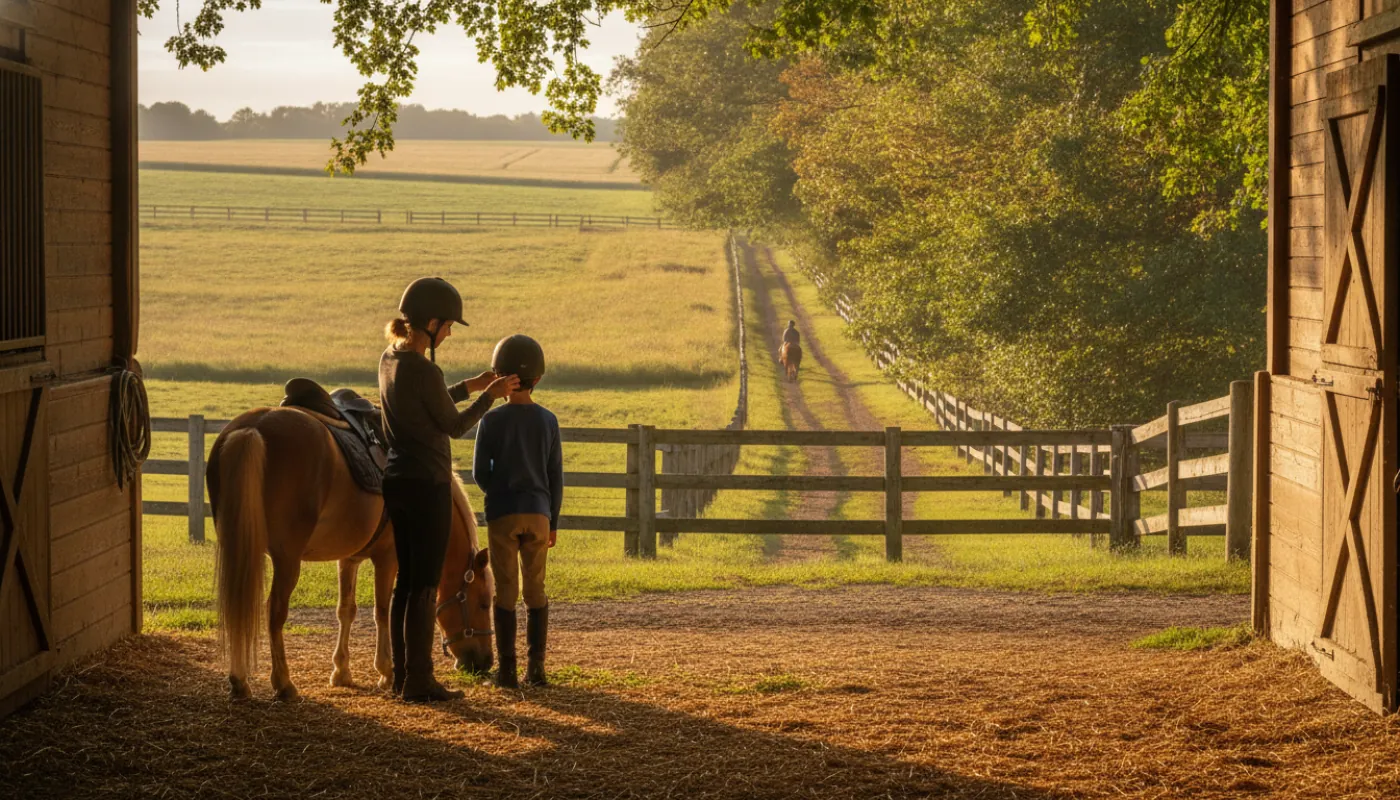
Before you hand your child the reins, get the gear right. A helmet that doesn't fit properly is worse than useless, it gives false confidence and offers zero protection. A riding vest that's too tight will come off the moment your kid reaches for the mounting block. The difference between proper protection and gear that merely looks the part determines whether a fall becomes a story or a tragedy. This guide cuts through the marketing and gives you what actually works: specific standards to look for, non-negotiable minimums, and the practical truth about what your child needs at each stage of riding. Whether your kid is taking a first lesson at a guest ranch or pursuing competitive riding, these are the layers that keep them safe.
The Helmet: Your Non-Negotiable Starting Point
A riding helmet is not optional, and it is not a fashion statement. It is the single most important piece of protection your child wears, because falls happen to everyone, beginners and advanced riders alike. The helmet's job is to absorb impact energy and keep your child's brain from hitting the inside of their skull. No helmet means a head injury that changes their life. A cheap helmet that doesn't stay on means the same outcome.
Insist on an ASTM F1163 helmet certified by SEI. The two work together: ASTM F1163 is the North American equestrian standard, and SEI (the Safety Equipment Institute) is the independent body that verifies a helmet was actually tested to it. A helmet stamped "ASTM F1163" without SEI certification is only a manufacturer's claim, so look for both marks. And never substitute a bike, skate, or ski helmet, those are built for a single forward-impact profile and do not protect the back of the head against the fall-from-height and hoof-strike risks an equestrian helmet is designed for. Certification, not price, is the safety signal: a certified helmet from a brand like Troxel, Charles Owen, IRH, or Tipperary can cost as little as $40–90 and protects better than an uncertified helmet at any price. Pay more for better ventilation or a nicer fit if you want to, but don't assume an expensive helmet is a safe one, or that a budget certified one isn't.
Fit is everything. A helmet that shifts or rotates when your child shakes their head is not protecting them. The helmet must sit level on the head, covering the forehead without tilting back, and the chin strap must be snug enough that you cannot fit more than one finger under it. Take your child to a tack shop to try helmets on, do not order online. Sizes vary dramatically between brands, and a child growing fast may need remeasuring every six months. Replace any helmet after a significant fall or impact, even if it looks fine, the foam crushes permanently and will not protect in a second impact. Replace it on schedule regardless, roughly every five years from the purchase date, because the materials degrade with age, sweat, and sun even if the helmet is never dropped.
Body Protection: Vests and Armor
A helmet protects the head; a riding vest protects the spine, ribs, and vital organs. Kids are lighter and more flexible than adults, which makes them more likely to bounce when they hit the ground, and more likely to land hard on their back or side. A good vest absorbs the energy that would otherwise damage developing bone and tissue.
There are two distinct kinds, and they aren't interchangeable. Foam body protectors are the standard for young riders in lessons and on the trail: rigid-but-flexible foam panels layered through a fitted vest that absorb impact and shield the spine and ribs. Look for one certified to ASTM F1937 (the US body-protector standard) or EN 13158:2018, the BETA 2018 "Level 3" blue label is the benchmark recommended for everyday riding. Reputable makers include Tipperary, Charles Owen, Racesafe, Airowear, Champion, and Ovation. Air vests are a separate category: a CO2 canister inflates an airbag around the torso and neck the instant the rider leaves the saddle. They come from specialists like Hit-Air, Point Two, and Helite, are often required in eventing cross-country, and are usually worn over a foam protector rather than instead of one. For a child in lessons or on the trail, a well-fitted foam protector is the right place to start. Either type should let your child move freely at the walk, trot, and canter; if they complain of restriction, size up or try a different brand.
Fit matters as much as it does for helmets. A vest that is too big will shift during a fall and leave gaps. A vest that is too tight will come off when your child tries to mount, or they will refuse to wear it. Have your child wear their usual riding shirt and try vests on over it. They should be able to take a deep breath and move their arms in full circles. Check that the vest sits evenly on the shoulders and covers the lower ribs. Look for vests with adjustable side panels so you can dial in the fit without buying new ones every growth spurt.
Footwear and Leg Protection
Proper riding boots are not a luxury; they are engineered for grip and safety. A regular sneaker or casual shoe has a sole designed for walking. When your child's foot is in a stirrup, a shoe sole that is too sticky or textured can catch if they fall, preventing their foot from sliding clear. A boot with a smooth heel and sole lets the foot slip free. The heel height (typically one inch for kids) keeps the foot from sliding too far into the stirrup. Riding boots start at $60–100 for quality brands like Ovation or Ariat, and they last for multiple seasons if cared for.
Tall boots are traditional in English disciplines and offer leg protection as a bonus, but half-chaps or chaps worn over sneakers or paddock boots are equally safe if fitted properly. Chaps protect the inside of the leg from stirrup leather rubs and the outside from brush and contact with the horse's side. They are optional for beginner lessons but become practical once your child is riding regularly. Skip chaps in hot climates unless the riding is in brush.
Stirrup safety is overlooked by many parents. Standard fixed stirrups can trap a rider's foot in a fall. Several safety-stirrup designs reduce that risk: Peacock stirrups (a rubber band on the outer side that pops off under load), bent-leg or S-shaped stirrups, and toe-cage stirrups that keep the foot from sliding too far through. Many lesson barns fit one of these on children's horses for exactly this reason. Ask your stable what they use, and if it's plain fixed stirrups, ask why. Wool or thick socks are important too, they cushion the foot in the boot and wick away sweat.
Layering and Environmental Gear
Children do not regulate body temperature as efficiently as adults, and hypothermia in young riders sneaks up fast. Teach your child the rule: layers in winter, minimal layers in summer, always a long-sleeved shirt underneath. A thin synthetic base layer (not cotton) wicks sweat and regulates temperature better than a thick cotton shirt. Riding pants in denim or stretch material protect the legs from stirrup rubs and brush. In winter, add a waterproof jacket over a fleece, it keeps them warm and dry without bulk.
Gloves are essential. Hands lose heat rapidly, and cold hands lose grip. Gloves also protect if your child falls and puts out their hands to catch themselves. Riding gloves have grip patches on the palm and fingers; basic versions cost $15–25. In winter, insulated riding gloves are worth the investment. Your child should also wear a long-sleeved shirt for visibility and sun protection. Bright or light-colored clothing makes them more visible to vehicles if they're on a road, and sleeves protect skin from sun and scrapes.
Weather extremes require specific prep. On hot days, limit riding to early morning or late afternoon, use lightweight fabrics, and always bring water. On rainy days, a waterproof jacket is mandatory, as wet gear conducts cold quickly and restricts movement. Never let your child ride in lightning, even a storm miles away can strike from a clear sky. In extreme cold, hypothermia can set in within an hour on a still, windy day. If your child shivers or loses dexterity, end the ride and get them warm.
Building the Right Kit for Your Child's Level
Your child does not need full gear for a first lesson at a guest ranch. A borrowed helmet from the stable, jeans, and sneakers get a beginner through an introductory trail ride. But if your child is starting formal lessons or will ride regularly, invest in the three essentials (helmet, riding boots, and riding pants), before the first lesson.
As your child progresses, add a safety vest. Most barns that teach jumping or advanced riding require one by the time kids are cantering or jumping, so ask your instructor when your child should get one. A good vest lasts two to three years if your child is growing normally, and used vests in good condition can be found for $50–100 on equestrian resale sites if budget is tight. Chaps and gloves come next, depending on the discipline and climate.
Test gear before you buy it. Many barns have loaner helmets and vests for the first few lessons. Visit a tack shop and try multiple brands, your child's fit is unique, and mail-order returns waste time and money. Talk to the barn staff and instructors; they see hundreds of kids ride and know which gear actually works. Ask for used-gear recommendations, too. High-quality hand-me-downs from older kids are safe as long as the helmet has not been crashed and the vest is intact.
Budget honestly. A complete beginner kit (helmet, boots, vest, pants, and gloves), costs roughly $300–500 if you buy new. That feels like a lot until you realize a single fall without a vest can mean weeks of missed school and a hospital bill. Start with the helmet and boots, add the vest when your child is ready for more advanced riding, and fill in the rest as they progress.