The choice between western and english riding feels monumental when you're new to horses, but it doesn't have to be. These two traditions developed for entirely different purposes (one born from cattle ranching and long-distance travel, the other from European sport riding and refined technique), and that history shaped everything: the saddle, the position, the disciplines, even the way riders communicate with their horses. Yet the good news is that both work beautifully when matched to their intended purpose, and many riders benefit from understanding both styles. Rather than wrestling with which is "better," this guide walks through the real differences so you can choose the path that aligns with your goals, your body, your local facilities, and your riding vision.
The Saddles: Where It All Starts
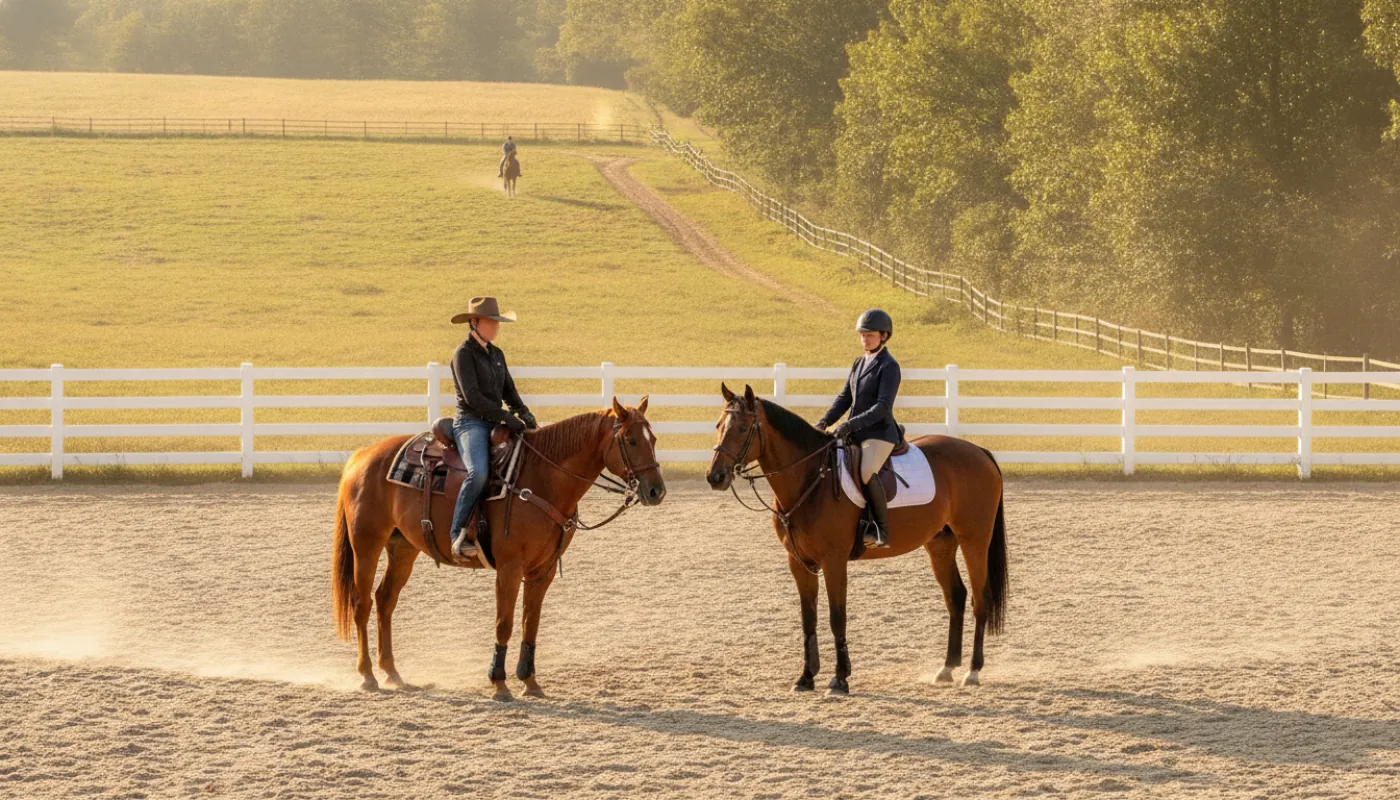
The first thing you'll notice, and the most dramatic difference, is the saddle. A western saddle is a substantial piece of equipment: heavy, durable, and built to keep you comfortable for eight hours of ranch work without complaint. It sits deeper and covers more of the horse's back than an english saddle, and it features a horn at the front, originally used for dallying, wrapping a rope around it, when working cattle. The seat is deep and welcoming, the stirrups hang well forward of vertical, and the overall design distributes your weight over a large surface area. This is the saddle of a working rider, one who values comfort, security, and the ability to stay in the saddle through long stretches of steady work.
An english saddle, by contrast, is small, light, and minimal. It has no horn and sits close to the horse's withers, right where you can feel the horse's spine and shoulder moving beneath you. Stirrups hang nearly vertical. There are variants, and their seats differ: close-contact and jumping saddles are shallow and forward-cut for sport, dressage saddles have a deeper seat and straight flap for precision work, and hunt-seat saddles serve hunter classes and foxhunting. But all english saddles follow the same philosophy: get out of the way and let the rider connect directly with the horse's motion. The design reflects a tradition focused on sport, refinement, and partnership rather than long hours of work.
The difference between them isn't arbitrary or stylistic, it's functional. Western saddles evolved from Spanish vaquero tack and were refined over generations of ranch work across varied terrain. English saddles descend from European riding traditions where sport, competition, and technical mastery were the goal. Both designs solve real problems beautifully. A dressage saddle would be uncomfortable on a twelve-hour trail ride; a western saddle would be clumsy in a jumping arena. Understanding what each was built to do clarifies why they exist.
Posture, Technique & How You Sit
Your body position changes dramatically depending on which saddle you're sitting in, and that difference carries real meaning. In a western saddle, you sit deep and centered, with a relaxed, upright posture and a very slight backward lean. Your legs extend fairly forward, and your weight settles into the seat. This position is stable, comfortable, and forgiving, it's designed so you can stay balanced even when the horse moves unpredictably or shifts its weight. Western riders traditionally hold the reins in one hand, leaving the other free (a practical carryover from ranch work, when you might need to open a gate or handle cattle). Communication with the horse happens through rein cues, weight distribution, and subtle leg pressure.
English riders sit differently: more toward the front of the saddle, with a vertical spine and shoulders slightly forward of the hip. The leg hangs more directly underneath, creating what instructors call "vertical alignment." Both hands hold the reins independently, and the connection between rider and horse is constant and responsive. Every shift in your weight, every change in leg pressure, every adjustment of rein contact sends a message. English riding demands that you feel the horse (its stride, its balance, its responsiveness), and adjust precisely. The rider and horse are in nearly continuous conversation.
These differences reflect the actual demands of the work. Western posture suits steady, long-distance travel and the kind of work where a calm, obedient horse is more valuable than a reactive one. You need to be comfortable, secure, and able to handle the unexpected without losing your seat. English posture suits disciplines where responsiveness and precision matter: if you're jumping a four-foot fence, you need to feel the takeoff; if you're performing dressage, you need to communicate and adjust with every stride. New riders often find western position more intuitive, the saddle feels safer, the cues feel clear. English position takes longer to feel natural, but it opens up a range of disciplines where technique and athleticism shine.
Disciplines & What They're Built For
A rider who tells you they do "western riding" might mean anything from relaxed trail riding to barrel racing to working cattle. A rider who does "english riding" might specialize in dressage, jumping, eventing, or hunter classes. The traditions support entirely different sports and purposes, and understanding which disciplines sit under each umbrella helps you see why the equipment and technique differ so fundamentally.
Western disciplines include trail riding, ranch work, western pleasure, barrel racing, roping, and reining. What they share is an emphasis on a calm, responsive, obedient horse. In barrel racing, you'll accelerate hard around obstacles, but the horse still needs to be controlled and focused. In reining, the horse slides dramatically and spins, but all under quiet, light cues. Working cattle demands a horse that can move smoothly, think independently, and stay unflappable around livestock and rope. Western events test partnership and obedience; they don't ask the horse to jump or to perform intricate precision movements.
English disciplines cover jumping, dressage, eventing, and hunter classes. These sports demand athleticism, engagement, and precision. Jumping requires a horse and rider team that can approach obstacles cleanly, calculate distances, and adjust on the fly. Dressage is classical, a conversation between rider and horse, performed in an arena with judges evaluating every step and every transition. Eventing combines dressage, cross-country jumping (riding fast over varied natural obstacles), and show jumping. Hunter classes evaluate a horse's movement, jumping style, and manners. These disciplines assume a horse that is trained to engage, to collect energy, to respond to subtle cues, and to perform demanding movements with precision.
The choice becomes clear when you think about what appeals to you: if you want to explore trails, spend hours outdoors, or work with livestock, western is your tradition. If you want to compete in structured sports, jump obstacles, perform dressage, or chase the refinement that comes from studying a discipline deeply, english offers that path. Many riders never have to choose, they'll ride western on weekends and take english lessons during the week, finding that each perspective sharpens their skills in the other.
Deciding Between Them: Which Should You Learn?
Your choice depends on several practical and personal factors, and there's rarely a single "right" answer, only the right answer for you, right now. Start with your goals. What drew you to riding in the first place? If you dream of long trail rides, ranch vacations, wide-open spaces, and the kind of riding that doesn't demand perfect form, western is the natural fit. If you're competitive, drawn to sport, or excited by the idea of mastering technique and advancing through levels, english gives you that framework. If you're honestly not sure yet, both are valid starting points, and a good instructor can help you explore.
Consider access next. Where do you live and what facilities are nearby? Rural areas, guest ranches, and dude ranches emphasize western; that's what their horses are trained for and what their instructors teach. Urban equestrian centers, competition barns, and riding clubs tend to teach english. Your geography may actually dictate the choice for you, and that's perfectly fine, start where you are and learn from experienced riders around you.
Think about your body too. Some riders find western saddles supremely comfortable and english saddles confusing; others feel at home in the english saddle immediately and find western awkward. If you can, sit in both saddles at a standstill and get a sense of which feels natural. Your comfort matters, and your body will tell you what it prefers.
Consider temperament as well as goal. Western riding, especially trail riding, is often more forgiving for beginners. The saddle is comfortable, the cues are straightforward, and you can cover ground without years of technical study. English riding asks for precision from day one: your position matters, your rein contact matters, small details matter. Some riders thrive under that kind of attention and feedback; others find it stressful at first. Neither response is wrong, and knowing yourself helps you choose wisely.
Finally, think about the long view. If you're riding purely for recreation and just want to enjoy trails and ranch experiences, western may be your lifetime discipline, and that's complete and satisfying. If you're competitive or drawn to continual refinement, english disciplines offer a lifetime of study and challenge. Many experienced riders recommend trying both, the skills and awareness from each strengthen the other, and a well-rounded rider can eventually adapt to either tradition with confidence and flexibility.