A multi-day horse pack trip is fundamentally different from a weekend trail ride or a daily lesson loop. You're not returning to a stable at sunset; you're sleeping under stars, eating camp meals, and spending most of the day in the saddle (commonly four to six hours, with the occasional long day pushing seven or eight), over terrain that gets increasingly remote. For operators and guests considering pack-trip outfitters, understanding what's actually involved (the physical demands, the logistics, the rhythm of backcountry camp life), separates informed decision-making from romantic fantasy. This guide covers the realities: what your body will experience, what an outfitter's job entails, what gear matters, and how to mentally prepare for the immersion.
Beyond the Day Ride: How Pack Trips Reshape the Riding Experience
A day ride ends when you're tired. A pack trip continues whether you're tired or not, because camp needs to be reached, water needs to be hauled, and tomorrow's start time doesn't change. That's the central difference, and it reframes every aspect of the experience.
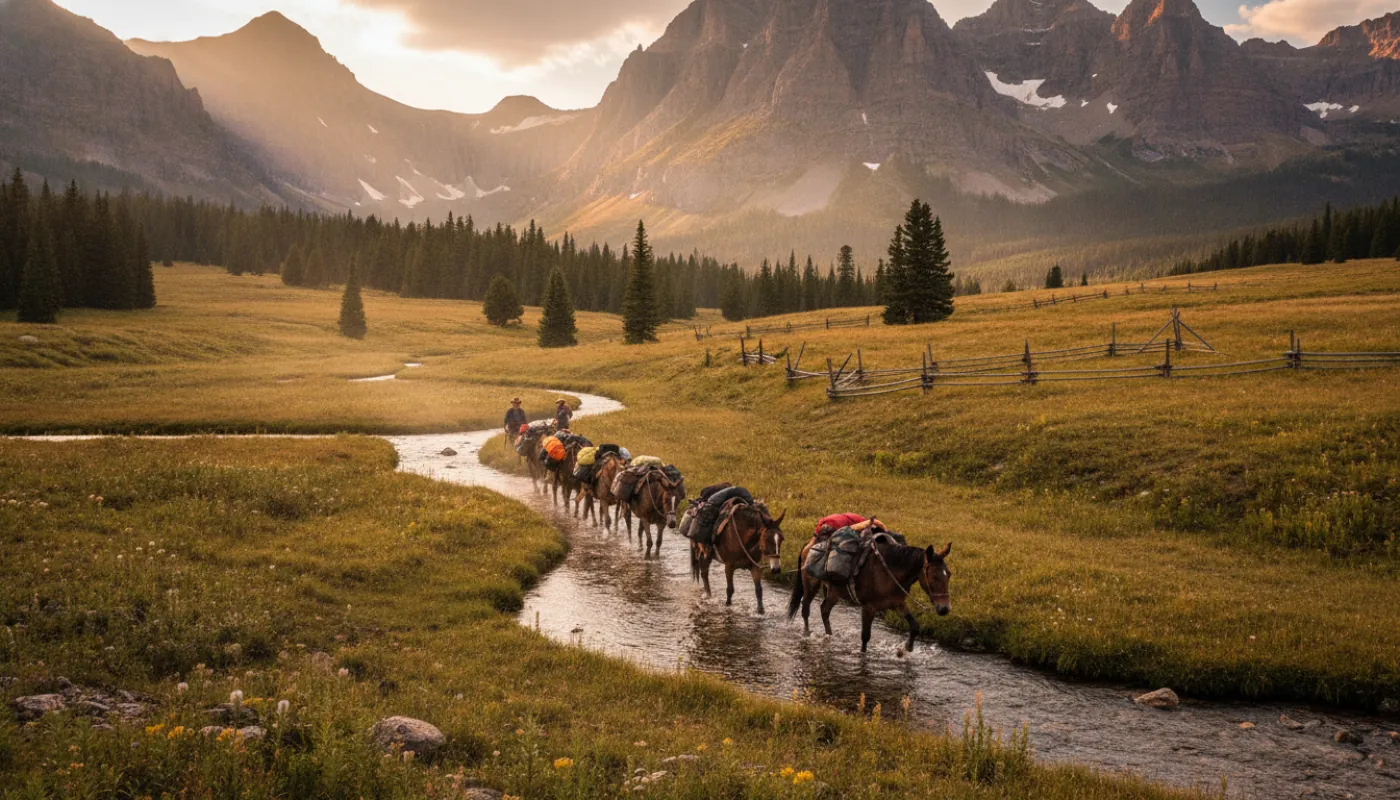
On a pack trip, your horse is doing real work, not just carrying you, but carrying supplies in panniers or packs lashed across its back or loaded on mules dedicated to freight. You're navigating terrain that may not be manicured or heavily trafficked. Navigation itself becomes part of the skill: reading a map, trusting your outfitter's route-finding, and understanding that wrong turns aren't ten minutes to a parking lot; they're decisions with consequences measured in miles and hours. The social fabric is different too. You're not with your home stable community; you're living in close quarters, often in shared tents, with strangers who become companions over four or five days.
This also means the ride isn't about performance or progression in the way stable riding is. It's about endurance, adaptation, and accepting the unpredictability of weather, wildlife encounters, and unexpected river crossings. For outfitters, it's the most lucrative and rewarding service to offer, the guests leave transformed, but it requires infrastructure, liability awareness, and staffing that day rides do not. For riders, it's an earned adventure: the conditioning must be real, the equipment must be sound, and the commitment must be sincere.
The Physical Reality: Hours, Soreness, and Honest Conditioning
Plan for four to six hours in the saddle on a typical day (not continuous, but spread across a long morning and early afternoon, with breaks for lunch and water stops), and an occasional long day of seven or eight. That's roughly double or triple what most recreational riders clock in a week, compressed into a single day. By hour four, your legs have forgotten what comfort feels like. By hour six, your lower back is renegotiating its deal with gravity. By day two, your glutes have filed a formal complaint.
Novice riders and those who ride casually, once a week or less, will experience soreness that lasts 3–5 days after the trip ends. It's not injury; it's the muscular adaptation that comes from sustained exertion beyond your usual threshold. Your thighs, glutes, lower back, shoulders, and the small stabilizer muscles around your hips and knees are all under load. Experienced riders, those riding 3+ times weekly on varied terrain, will still be sore, but it'll fade by day four of the trip or shortly after. There's no way around this. Gel pads, expensive saddles, and wishful thinking don't prevent it; conditioning does.
The practical remedy is pre-trip conditioning. Start 4–6 weeks before departure with daily or every-other-day rides of increasing length. Week one: 60–90 minutes. Week three: 2–3 hours. Week five: 4+ hours on varied terrain: hills, technical footing, both walk and trotting. Lunging and groundwork don't substitute for saddle time; you need to be in the seat, feeling the fatigue, so your body adapts. Yoga, core work, and stretching all help, but they're supplementary. By trip start, you should be riding 4+ hours without significant soreness. If you're not, you'll spend the first two days suffering instead of present.
What the Outfitter Handles & Why Choosing Right Matters
A competent outfitter carries the entire logistical backbone. They route-plan according to group fitness level and water availability. They manage the pack stock, mules or horses dedicated to cargo, and ensure each animal is loaded appropriately for balance and welfare. They scout camp sites, bring or purify water, prepare meals, and break camp in the morning. They carry emergency communication (satellite communicator or radio), a first-aid kit, and knowledge of the terrain and wildlife patterns in their area. On most western national forests, BLM land, and in designated wilderness they're also legally required to pack only certified noxious-weed-free forage or processed feed, a rule with real fines behind it that keeps invasive seeds out of the backcountry, and to follow Leave No Trace practices for stock, high-lining or picketing horses well away from water and rotating grazing so the country stays rideable. A professional outfitter already has all of that handled.
This operational competence is non-negotiable. A poorly-managed pack trip becomes a survival exercise in misery: cold food, no water, camp in the dark, a horse that goes lame from improper loading. A well-run trip feels effortless because someone else is solving problems before you see them. Your job is to ride, eat, sleep, and be present. The outfitter's job is to make that possible.
When choosing an outfitter, ask about their experience, references, and liability insurance. Confirm they're actually authorized to operate where they guide: a legitimate backcountry outfitter holds a USFS special-use or NPS permit for the land, and in most western states a state outfitter/guide license, both are checkable credentials, not just marketing. Ask, too, about the rider weight limit up front; most outfitters cap riders around 200 to 240 pounds, because a horse safely carries only about a fifth of its body weight, so anyone near that range should confirm before booking rather than be turned back at the trailhead. Ask what's included (meals, tents, sleeping bags, horse), and what you're expected to bring. Ask about daily mileage and elevation gain, because "we ride at sunrise and camp by 3 PM" is very different from "we're in saddle for 8 hours over 3,000 feet of elevation." Ask about group size; six riders is manageable; twelve is logistically overwhelming. Ask how they handle weather: rain, cold, unexpected river swells. A professional outfitter will answer directly and comfortably. Vague answers or defensiveness should send you elsewhere. The outfitter-rider relationship is a trust contract; it's worth vetting.
Gear and Packing: What Weighs and What Stays
Your outfitter will tell you what to bring and will give you a firm weight limit for your personal duffel, commonly 30 to 35 pounds, sometimes up to 45. That includes everything: clothing, toiletries, sleeping bag if you're bringing your own, personal items. It's generous for five days, tight if you overpack comfort items. Remember: everything you bring rides in a pannier or duffel bag strapped to a horse. Weight matters for the animal; excess weight creates soreness, and a sore pack horse is a day delayed or a ride cut short.
Pack layers, not bulk. Three merino wool or synthetic long-sleeve shirts, one warm insulating layer (fleece or down), one waterproof outer layer, underwear for five days, warm socks (not cotton), riding breeches, and sturdy boots you've ridden in before, nothing new or untested. One pair of camp shoes, not flip-flops. A warm hat for cold mornings and evenings. Rain gear must be reliable; a $15 poncho fails in a downpour; invest in a real rain coat. Include a headlamp or small flashlight for navigating camp at dusk.
Toiletries: toothbrush, toothpaste, sunscreen, lip balm, and any personal medications or pain relief. Forget daily shower luxuries; a washcloth and biodegradable soap let you rinse off in streams. Pack feminine hygiene items (or bring extras of whatever is relevant to you); outfitter camps often lack access to resupply. A small notebook and pen cost nothing and serve double duty, journaling and topo-map notes. Leave behind: hairdryers, curling irons, makeup beyond sunscreen, jewelry, electronics beyond a camera, books (too heavy). Phones rarely have service, and the point of a pack trip is to disconnect.
Most outfitters provide the saddle, tent, cook gear, and meals, but the sleeping bag is the item they most often expect you to bring yourself, along with a pad, so confirm exactly what's included before booking. If you're bringing your own saddle, it must be pack-trip rated, not too heavy, balanced, and proven comfortable over long days. A $2,500 English saddle is a liability if you've never ridden in it for eight hours. Borrow and test first.
The Mental Transition: Unplugging and Living in the Rhythm
The first night away, almost every rider lies awake listening to unfamiliar sounds (wind, animals, the creek, other riders shifting in sleeping bags), and wonders what they've signed up for. By the third night, many riders fall asleep during dinner and wake at dawn naturally, craving nothing but coffee and the day's ride. That psychological shift is half the value of a pack trip.
Unplugging is real, even for people who think they can't. There's no phone signal, no email, no algorithm-driven feeds. Your mental diet becomes the landscape, the people around the fire, and the physical sensation of riding. Anxiety doesn't vanish, but it quiets. Problems back home seem smaller. By day four or five, many riders report a kind of mental clarity they haven't felt in months.
Group dynamics matter. You'll tent with one or two other riders, often strangers. Shared space breeds honesty quickly, vulnerability creates bonds. An introvert should know this going in and choose an outfitter with small groups or private tent options if solitude is essential. A social rider will thrive with a larger group. Ask your outfitter about group composition before booking; a group of experienced riders has a different energy than a mix of novices and veterans.
Weather variability is real and cannot be fully predicted. A forecast of "partly cloudy" can shift into afternoon thunderstorms in mountain terrain. Pack trips run through weather; outfitters don't cancel for rain. That means riding in conditions you might avoid at home, and it's okay. It builds competence. It also means your mindset, whether you're irritated or embracing the experience, shapes how much you enjoy a rainy day. Experienced riders know this going in and dress for it. Novices often don't, and they spend the day miserable. Come prepared, stay flexible, and trust your outfitter's judgment about safety thresholds.
Riding the Rhythm: What Each Day Actually Looks Like
Dawn comes early, usually a 6 or 6:30 AM wake-up with coffee and breakfast by 7 AM. By 8 AM, you're saddled and moving, climbing out of camp on a trail that gets increasingly steep and technical as the morning progresses. Midday brings a lunch stop, often near water, where you dismount, loosen cinches, and eat sandwich wraps or trail mix. By 2 or 3 PM, the outfitter spots a camp site (near water, with adequate pasture for the animals, sheltered from wind), and begins the afternoon work: unpacking, setting up tents, gathering firewood, and starting dinner while riders tend to their horses or collapse in camp.
Evenings are social and quiet. Dinner around a fire, conversation that drifts toward the landscape and the day's observations, early bed times because your body is genuinely tired. No one stays up past 8 PM. Morning soreness is real on days two and three; by day four, your body has adapted and you're moving easier. The final day often feels too short, even though it's the same length as the others. By then, you've found the rhythm, the trail feels familiar, and you realize the trip is ending.
This rhythm (early start, hours of riding, camp setup, fire and food, sleep, repeat), is both the difficulty and the magic. Your life simplifies to its essentials. You eat when food appears, ride when it's time to ride, and sleep when darkness falls. It sounds primitive, and it is. It's also restorative for people whose daily lives are structured around complexity and choice.
An honestly-run pack trip isn't a luxury resort experience; it's an earned adventure into sustained self-reliance. Choose an outfitter with solid references, arrive in genuine condition, pack thoughtfully, and bring an open mind to discomfort. The soreness fades in a week. The memories last years.